About
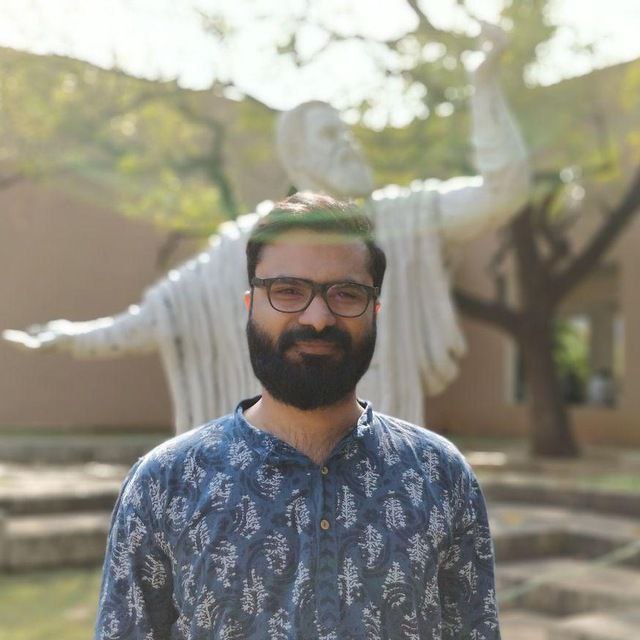
Dr. Rafikh Rashid Shaikh is a learning scientist and science-education researcher, and a member of the Gnowledge Lab. He currently serves as Senior Research Coordinator at the Centre of Excellence in Teacher Education (CETE), School of Education, Tata Institute of Social Sciences, Mumbai, where he designs and implements educational modules that bridge theory, practice, and real-world scientific inquiry.
A long thread of his research, carried out with Nagarjuna G., used an instant-messaging application running on networked computers (including OLPC deployments) in a rural school at Khairat, to support both numeracy and literacy in primary-school children. The studies — reported across epiSTEME, CSCL, ICME and Education and Information Technologies — showed that an externalised shared memory in a collaborative, game-like setting can both accelerate learning and sustain motivation. See the Shared Memory Space research thread for the framing.
With Dr. Shamin Padalkar, Rafikh developed embodied astronomy modules for students and professional-development courses for teachers as part of the Connected Learning Initiative (CLIx) — work that contributed to CLIx being awarded the UNESCO King Hamad Bin Isa Al-Khalifa Prize for the Use of ICTs in Education. His broader interest is in fostering curiosity, scientific literacy and meaningful engagement with science among both learners and educators.
He has also co-authored, with Amit Dhakulkar, the 2016 essay A slate for every child: rethinking education in the age of computers.
Beyond his research, Rafikh suggested the name naYana (a phonetic palindrome — nYn — that in Sanskrit means eye) for the lab’s naYana phonetic alphabet project.
He is also an active promoter of Foldscope in India — the origami paper microscope developed by Manu Prakash’s group at Stanford — helping bring frugal, durable, sub-dollar microscopy into school and undergraduate classrooms and into the lab’s investigative-biology and home-lab work.
Awards and fellowships
- Seal of Excellence — European Union’s Horizon Europe / Marie Skłodowska-Curie Actions (MSCA), in recognition of the quality of his research proposals.
- Foldscope Fellowship — Stanford University (Prakash Lab).
- Citizen Science Fellowship — EarthWatch.
- Swachhata Sarathi Fellowship — Office of the Principal Scientific Advisor to the Government of India.
- UNESCO King Hamad Bin Isa Al-Khalifa Prize for the Use of ICTs in Education — awarded to the Connected Learning Initiative (CLIx), to which he contributed astronomy modules and teacher PD with Dr. Shamin Padalkar.
Research interests
- Computer-supported collaborative learning (CSCL) in school classrooms
- Shared-screen / shared-memory mediation of learning and conversation
- Instant messaging and chat as constructionist learning contexts
- Numeracy and literacy in primary schools, including in rural / OLPC settings
- Embodied and interactive approaches to science teaching (e.g. astronomy)
- Teacher professional development; design of school-level science modules
- Zone of Proximal Development in connected, networked learning environments
Projects
- Shared Memory Space — chat / IM-mediated primary-school learning at Khairat, with Nagarjuna G.
- Connected Learning Initiative (CLIx) — astronomy modules for students and PD courses for teachers, with Dr. Shamin Padalkar
- naYana — suggested the name for the phonetic alphabet (the palindrome nYn)
- chatShaala — part of the lab’s wider thread on conversational learning environments
- Foldscope outreach in India — promoting the origami paper microscope as a frugal scientific instrument in schools and colleges
Publications
- Rafikh Shaikh, Nagarjuna G. & Ayush Gupta (2023). Investigating the role of shared screen in a computer-supported classroom in learning. Education and Information Technologies. [PDF]
- Rafikh Shaikh, Padalkar, S, Sutar, P & Kumar, A (2020). Learning Basic Astronomy Through an Embodied and Interactive Approach. International Conference to review research in Science Technology and Mathematics Education. [PDF]
- Rafikh Shaikh, Harita Raval, Harshit Agrawal & Nagarjuna G. (2020). Impact of computer-mediated sharing on classroom activities. The 14th International Congress on Mathematical Education Shanghai. [PDF]
- Rafikh Shaikh, Amit Dhakulkar & Nagarjuna G. (2018). Zone of Proximal Development in the Era of Connected Computers. S. Ladage and S. Narvekar (Eds.), Proceedings of epiSTEME7: Seventh International Conference to Review Research on Science, TEchnology and Mathematics Education, HBCSE (pp. 214-221). India: CinnamonTeal. [PDF]
- Rafikh Shaikh, Harshit Agrawal, Nagarjuna G. & Mrunal Nachankar (2017). Instant Sharing Makes Task More Engaging in Computer Aided Classroom. Proceedings of CSCL, pp. 609-612. [PDF]
- Amit Dhakulkar & Rafikh Shaikh (2016). A slate for every child: rethinking education in the age of computers. Teacher Plus Magazine. [PDF]
- Rafikh Shaikh, Nagarjuna G. & Sanjay Chandrasekharan (2013). Socialising Mathematics: Collaborative, Constructive and Distributed learning of arithmetic using a chat application. In Nagarjuna G., Arvind Jamakhandi, and Ebie M. Sam (Eds.) Procceedings of epiSTEME-5, pp.321-327. [PDF]
Elsewhere on the web
- TISS / CETE: (to be added)
- ORCID: (to be added)
- LinkedIn: (to be added)
- X (Twitter): (to be added)
- Bluesky: (to be added)
- metaStudio: (to be added)
- Personal site / blog: (to be added)
Contact
(public email to be added)
To collaborate with the lab community, the recommended channel is metaStudio.org.